
The Impact of Non-Thermal Technologies on the Printability and Functional Properties of Quinoa Protein-Based Food Ink
Volume 22, Issue 5, November and December 2026, Pages 449-472
https://doi.org/10.22067/ifstrj.2026.97432.1545
Mozhdeh Sarraf, Sara Naji-Tabasi, Behrooz Ghorani, Bahareh Emadzaeh, Omer Said Toker
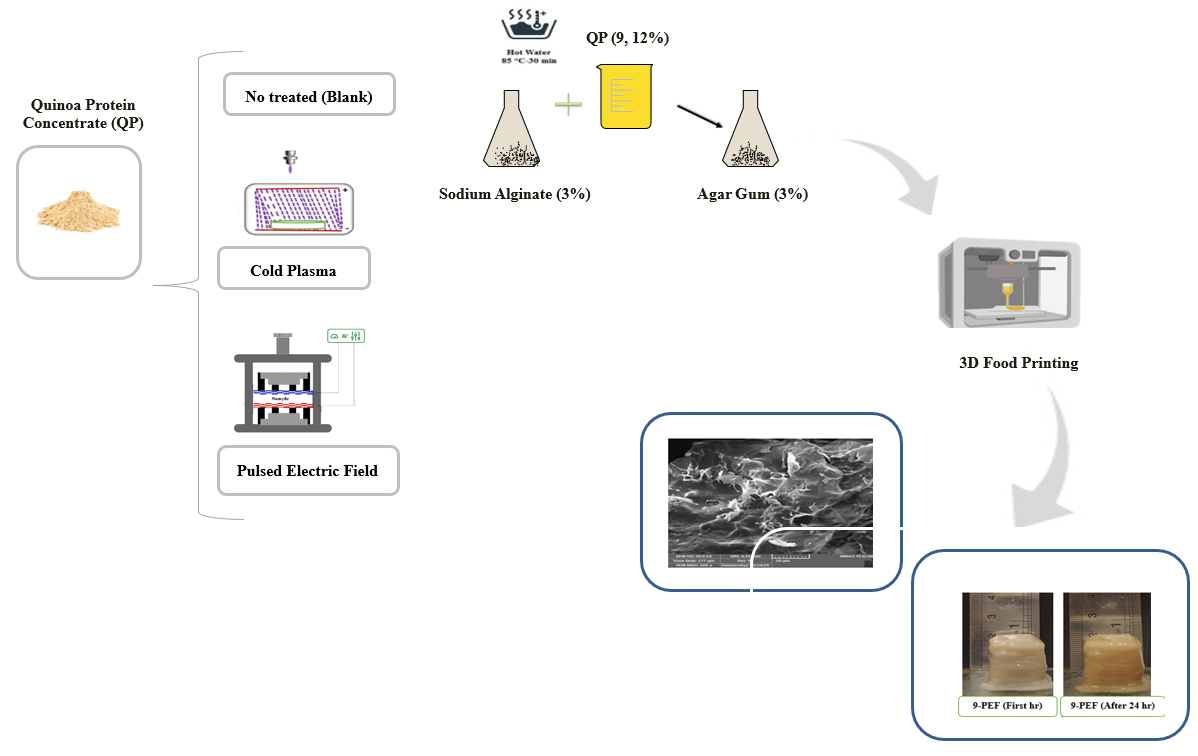
Abstract In the past decade, the food industry has seen increased focus on diverse and practical designs. Accordingly, this research aims to use additive manufacturing to create gel structures from a new perspective. In this study, quinoa protein (QP), either untreated (B) or treated with cold plasma (CP) or pulsed electric fields (PEF), at two concentrations (9 and 12% w/w), was combined with polysaccharides (alginate and agar) to prepare gels. The printability and physicochemical (water activity, dry matter, water holding capacity, and color analyses), textural, and rheological properties of gels were then compared. Evaluation of the textural properties revealed that the highest hardness was observed 530.27, 416.52, and 334.82 g for the 12% B, 12% CP, and 9% PEF samples, respectively. However, in examining the results of the frequency sweep, 9% and 12% CP had the lowest storage modulus among the other gels. The 3D printing results of gels indicated that they are printable and showed high stability over 24 hr. In addition, phase separation did not occur in all treatments when gels were exposed to severe stress. Therefore, optimizing quinoa protein gels for 3D printing requires coordinating processing parameters with the composition of the formulation. This could advance the development of novel food designs with enhanced texture and stability, aligning with the food industry’s focus on innovative and practical solutions.
Nano-encapsulation of Red Beetroot Extract Based on Betalain Using of Complex Coacervation in Gummy Candies
Volume 21, Issue 2, May and June 2025, Pages 147-164
https://doi.org/10.22067/ifstrj.2024.88135.1333
Atfeh Ghorchi, Akram Arianfar, Vahid Hakimzadeh, Sara Naji-Tabasi
Abstract Introduction
Red beet has nutritional and health-promoting properties due to containing bioactive compounds such as phenolic compounds and betanin. Co-encapsulation of more than one core material in a single encapsulation system may increase the bioactivity of individual components. Customer attitudes and behaviors have moved towards health foods because they have more concerns on increasing environmental stresses such as pollution and toxic substances in the environment. Confectionery products are not exactly foods, but they are widely consumed by children and adults. Traditional gummy confection consists of high amounts of synthetic colorings or flavorings in a gelling agent, commonly known as gelatin, along with acids and sweeteners. Natural color in the form of pigments is synthesized and accumulated in living biological cells of algae, vertebrates, invertebrates, fungi, lichens, or bacteria. The red color in food industry comes mainly from two pigments: anthocyanin and betalains. Among the major groups of natural pigments, betalains can be considered as the least studied, due to its limited sources. The main commercially produced crop containing betalain is red beet root, however many researchers are exploring red dragon fruit or pitaya as a viable alternative. Betalains, derived from beetroot are water-soluble nitrogenous pigments that stop or delay the oxidation process and exhibit anti-tumor and antiatherosclerotic effects. The application of red color from beetroot (mainly betalains) is permitted widely in ice cream, sherbet, yogurt, powdered soft drink mix along with confectionaries, soups, and bacon products. The stability of betalains varies with different levels of water activity, temperatures, exposure to oxygen, and light. Complex coacervation is one of the oldest and simplest techniques of encapsulating bioactive compounds for delivery in controlled manner. The technique associates simple preparation conditions, such as non-toxic solvent and low agitation, the techniques has also been employed in the encapsulation of protein and human cells. Microcapsules prepared by complex coacervation are water-insoluble, possessing excellent controlled-release characteristics. Complex coacervation is a technique by which phase separation occurs when oppositely charged polyelectrolytes are electrically balanced in aqueous media. This depends on relatively a set of conditions such as pH, charge density on the polymers, colloid concentration, ionic strength of the medium, temperature, etc. However, all polyelectrolytes do not exhibit this phenomenon.
Materials and Methods
The features of water activity, moisture, acidity, Brix, antioxidant activity, texture characteristics, colorimetry and sensory evaluation of pastilles were investigated. All analyzes were performed with three replications in a completely randomized design. Means were compared using Duncan's multi-range test at a significant level of 5% with SPSS version 22 software.
Results and Discussion
The results showed that water activity of samples containing nanomicrocoating of red beet extract was significantly lower than the control sample (p<0.05), but the moisture, acidity and brix of the sample containing nanomicrocoating of red beet extract were significantly higher from the control (p<0.05). During the storage period of 28 days, it showed that the sample containing 1.5% red beetroot extract's nano-coating had a significantly higher stability of the antioxidant property than other samples (p<0.05). The results of the histological test showed that the sample containing the red beet extract nano-coating had a significant decrease in hardness, stickiness and chewability compared to the control (p<0.05), but the degree of cohesion showed a significant increase (p<0.05). Examining the color parameters of the samples containing red beetroot extract nano-coating compared to the control sample also showed that it caused a decrease in brightness (L*) and yellowness (b*) and an increase in (a*).
Conclusion
The results of the sensory evaluation showed that the sample containing 1% red beetroot extract nano-coating was awarded the highest score compared to the control.
Improving the Physico-mechanical Properties of Extruded Rice Based on Mixed Rice-quinoa Flours Using Pickering Emulsion-filled Gel Containing Beta-carotene
Volume 21, Issue 2, May and June 2025, Pages 179-198
https://doi.org/10.22067/ifstrj.2024.89650.1361
Maryam Davtalab, Sara Naji-Tabasi, Mostafa Shahidi Noghabi
Abstract Introduction
Rice is a strategic product and considered as staple food of over half of the world's population particularly in Iran. Considering the high levels of rice waste, including broken grains or those of lower quality, it can be utilized for producing value-added foods and reducing waste. Extrusion is a process widely used to improve food products and develop fortified foods. Quinoa flour is rich in phenols, and can be utilized to produce fortified extruded rice. The extrusion of gluten free flours like rice and quinoa has different challenges. In this study, sodium alginate was used to prepare emulsion filled gel to enhance the stability of Pickering emulsions containing β-carotene and also structuring rice during extrusion process. Pickering emulsion is one of the encapsulation methods suitable for encapsulating lipophilic compounds like β-carotene. Emulsion-filled gels, developed using hydrocolloid mixtures, significantly enhance emulsion stability and make them suitable for aqueous food environments. Finally, extruded rice based on a mixture of rice- quinoa flours and fortified with beta-carotene was prepared, and its physico-mechanical properties were evaluated.
Materials and Methods
Pickering emulsions were stabilized using whey protein- cress gum soluble complex nanoparticles. Beta-carotene was dissolved in the oil phase at a concentration of 0.1%. Subsequently, 4% (w/v) sodium alginate was used to develop emulsions filled-gel.
The Pickering emulsion was dispersed in the sodium alginate gel at a ratio of 15:85. Extruded rice was then prepared using an equal ratio (50:50) of broken rice flour and quinoa flour via a cold extruder. To evaluate the impact of the gel-filled emulsion on improving the characteristics of rice grains, different concentrations (30%, 35%, and 40% w/w) of the gel-filled emulsion (based on flour weight) were added to the mixture. The physico-mechanical tests (moisture content, ash content, optimum cooking time, water absorption ratio, cooking loss, lateral expansion, textural characteristics of rice, color properties, sensory analysis, structural morphology, Beta-carotene stability) were conducted. Duncan test was utilized to identify statistically significant differences (p<0.05) among the means, while one-way analysis of variance (ANOVA) was employed to investigate the impact of various factors.
Results and Discussion
The incorporation of emulsions filled-gel into quinoa-rice blend significantly influenced the physico-mechanical properties of extruded rice. As the concentration of emulsions filled-gel increased from 30% to 40% (w/w), there was a significant increase in moisture content, ash content, expansion ratio, and cooking time. Extruded rice samples with emulsion-filled gel exhibited significantly greater β-carotene stability than those without, both after cooking and during storage. Conversely, adhesiveness decreased while hardness increased with increasing emulsion filled-gel concentrations. The control sample exhibiting the highest adhesiveness and lowest hardness. The lightness of the extrudates was also improved with increasing emulsion filled-gel levels, reaching a maximum at 40% (w/w). Sensory evaluation revealed that the 40% emulsion filled-gel level was the most preferred sample by panelists. The optimized extruded rice closely resembled natural Hashemi rice in terms of sensory and textural properties.
Conclusion
The findings of this study demonstrate that the addition of emulsions filled-gel enriched with beta-carotene can effectively enhance the physico-mechanical properties of extruded quinoa-rice blends. Specifically, increasing the emulsion concentration resulted in improving expansion, textural, and appearance properties of the rice. 40% emulsion filled-gel was found to be optimal, resulting in a product with desirable sensory attributes. This research proposes that extruded rice based on mixed rice-quinoa flours enriched with beta-carotene-loaded emulsion-filled gel can provide a nutritious and appealing alternative to broken rice products, leveraging the nutritional benefits of quinoa. Sensory and textural evaluation revealed that the extruded rice exhibited sensory properties highly similar to natural Hashemi rice, coupled with favorable cooking characteristics. Consequently, it can be introduced as a suitable substitute for natural rice.
Production of Reduced Fat Mayonnaise Using Stabilized Nano Emulsion with Casein Complex Pickerings and Shirazi Gadomeh Gum
Volume 20, Issue 4, September and October 2024, Pages 369-380
https://doi.org/10.22067/ifstrj.2023.80077.1227
Atena Modiri Dovom, Akram Arianfar, Sara Naji-Tabasi, Vahid Hakimzadeh
Abstract Introduction
Mayonnaise is a products which is widely popular in most countries. Apart from the desirable taste of this product as a seasoning, plays an effective role in providing nutrients and energy for humans. Dietary mayonnaise, is semi-solid or liquid product prepared from emulsification fat substitutes and vegetable oils with vinegar and other additives with less energy and fat. Fat has more calories (9 kcal/g) compared to protein and carbohydrates (4 kcal/g). Mayonnaise is an oil-in-water emulsion and due to having high amounts of fat it causes cardiovascular diseases. Gums are part of construction formula in low fat products to create texture. Due to the great desire to consume low-fat products and also the wide use of this sauce, production of low-fat mayonnaise is important. The purpose of this research was to develop reduced fat mayonnaise using stabilized nano emulsion with casein complex Pickering and Gadomeh Shirazi gum.
Materials and Methods
Mayonnaise with reduced oilcontains 30, 40 and 50 percent Pickering emulsion replacement oil respectively at the level of 42, 32 and 22 percent produced and compared with the control sample. Centrifugal and time stability tests, textural features, color characteristics, morphology, organoleptic properties were evaluated.
Results and Discussion
The results showed as the replacement percentage increases nano emulsion containing Pickering particles and reducing the percentage of fat in mayonnaise emulsion stability she found her mayonnaise sauce although at a replacement level of 30% nano emulsion, this decrease in stability was not significant (P<0.05). In the time stability test low-fat mayonnaise with an increase in the percentage of nano emulsion replacement, After 90 day’s significant difference between the control sample and mayonnaise no significant difference was observed with oil reduced by 30 and 40%. In the colorimetry test it showed that among the factors L*. a*. b statistically with the sample there was a significant difference (P≤0/05). Brightness In the witness sample, it was 48/85 in connection with RFM50% the least complex of particles Gadomeh Shirazi gum and casein protein and in relation to RFM30% the most complex of particles Gadomeh Shirazi gum and casein were used. Due to the presence of nanoemulsion contains complex particles Gadomeh Shirazi gum particles and protein. The brightness has decreased in general, from the RFM50% sample up to RFM 30% samples simultaneous with increasing amount of nanoemulsion and reduce the amount of fat the brightness is reduced.
Conclusion
By replacing the nano emulsion and reducing the amount of fat in the structure of the sauce the amount of tissue stiffness decreased and pheneritis increased. The sensory test of the samples showed, the witness sample has the most general acceptance but there is a significant difference between the samples there was no reduced-fat mayonnaise with the control. Investigating the characteristics of mayonnaise with reduced fat using nanoemulsion stabilized with complex Pickerings casein and Shirazi Gadomeh gum the results showed that with the increase, reduce the amount of oil up to 30%, Sensory and texture characteristics in a meaningful way decreased. But oil reduction up to 50% in the presence of Pickering nanoemulsion preserve textural features and promoted in some cases. All emulsions produced of favorable stability during storage and centrifugation had. Best stability in control and sample RFM-30% was observed. Based on the results, use of nanoemulsion maintains quality characteristics mayonnaise with oil especially reduced in the sample RFM 30%, it was. Also note to the point that Pickering emulsion structure in the digestive system high stability against digestion, is hope Pickering nanoemulsion structure in the production of food products various low-fat items be investigated further.
Production of nanoemulsion based on sweet almond and sesame oils using ultrasound and evaluation its properties
Volume 18, Issue 4, September and October 2022, Pages 514-526
https://doi.org/10.22067/ifstrj.2021.69078.1020
Masoumeh Heydari Gharehcheshmeh, Akram Arianfar, Elham Mahdian, Sara Naji-Tabasi
Abstract [1]Introduction: Sesame oil and sweet almond oil are rich in unsaturated fatty acids and antioxidant components, providing nutritional and functional properties including improvement of the gastrointestinal system, decrease in blood cholesterol level, eventually leading to a decrease in the risk of cardiovascular disease. The present study examined the possibility of the production of emulsion based on sesame and sweet almond oils and the effect of preparation on its stability.
Material and methods: Sesame oil and sweet almond oil with tween 80 and span 80 as emulsifiers were used in emulsion production. In order to prepare the nanoemulsions, the water and oil phases were prepared separately by the ultrasonic homogenizer. Ultrasonic waves were applied for homogenization and the effect of Ultrasonic time (5, and 10 min), oil content (2, and 4%), and emulsifier concentration (0.25, 0.5%) on particle size, particle distribution index (PDI), turbidity loss rate, emulsion stability and zeta potential of nanoemulsions were studied.
Results and discussion: Ultrasonic time had a reverse effect on particle size, particle distribution index (PDI) and turbidity loss rate and a direct effect on emulsion stability. The particle size and turbidity loss rate of prepared emulsions had a direct relation with oil concentration and a negative effect on emulsion stability. Emulsifier concentration had a positive effect on emulsion stability, a negative effect on emulsion stability, and had no significant effect on turbidity loss rate. According to the results of the effect of type and concentration of oil on particle size distribution, turbidity reduction rate and stability of nanoemulsions in all cases, samples containing sesame oil with a concentration of 2% compared to sweet almond oil, had better results, the presence of this oil led to the formation of nanoemulsions with smaller particles and greater stability. The produced nanoemulsions had a particle size between 200-320 nm, a stability of 91-98/7% and a turbidity reduction rate of 0.0010-0.0027. Also, the highest stability and zeta potential were reported 98.7 % and -33mV respectively, which belonged to sample k4. Therefore, this sample was selected as the optimal sample.
The results showed that the particle size, mean particle diameter, particle dispersion and turbidity reduction rate showed a significant difference between the samples, so that the lowest and highest were related to K4 sample (2% sesame oil, homogenization time 10 minutes and Emulsifier concentration ratio 0.5%) and sample B5 (almond oil 4%, homogenization time 5 minutes and emulsifier concentration ratio 0.5%) (p <0.05). The results also showed that the highest level of stability and zeta potential was related to K4 sample. Thus, the best nanoemulsion, K4 sample was introduced
Production of reduced fat muffins using soluble complex of egg white protein-xanthan gum oleogel based on foam molding
Volume 18, Issue 1, March and April 2022, Pages 40-50
https://doi.org/10.22067/ifstrj.2021.67365.1000
Reza Jaberi, Ahmad Pedram Nia, Sara Naji-Tabasi, Amir Hossein Elhami Rad, Masoud Shafafi
Abstract Introduction: Fats are widely used in food formulations to improve nutrients and quality of food products. In recent years, consumer awareness of the relationship between diet and health has increased, which results in increasing concerns about fats in products, in terms of high levels of saturated fatty acids. Therefore, various attempts have been conducted to find appropriate method to produce solid fats with unsaturated fatty acid content. The production of low-fat cake is of special nutritional importance due to the effects of fats and the incidence of various diseases such as hypercholesterolemia and cardiovascular. In cake making, oil is very important, first of all, it has an effect on keeping the air in the cake dough. It causes porosity and increases the volume of the cake. The conversion of liquid oils to gel-like structures that have the properties of a solid fat (rheological properties, viscoelasticity, dispersibility, and softness) without using large amounts of saturated fats is an important development in the food industry, and structures produced by oleogelation are called oleogels. Therefore, the main purpose of this study was to produce low-calorie muffins by removing fat and replacing it with an oleogel system prepared from a soluble complex of xanthan gum and egg white by indirect foam molding.
Materials and Methods: First, aerogels were produced indirectly using egg white protein complex and xanthan gum, and then oleogel was produced by adsorption of oil. In this method, first, water suspensions containing 0.5 wt% of xanthan and 5 wt% of egg white protein were prepared. In the next step, the oleogel was used to produce muffin with reduced oil in three levels of 10, 30 and 50%. In this study, texture characteristics, color, porosity, water activity, moisture, specific volume of muffin samples were investigated. In the control sample, cake dough contained 100% wheat flour, 50% sugar powder, 30% liquid vegetable oil, 2% baking powder, 0.2% vanilla, 36% eggs and 12% invert syrup. To prepare samples containing oleogels, oil was removed and different concentrations of oil reduction at the level of 50, 30 and 10% in the formulation were added to each treatment. Results and Discussion: Muffin with 10% reduced oil had the highest volume and density and had similar texture characteristics to the control sample. By reducing the amount of fat to 50% of the initial amount in muffin, the volume decreased and the firmness of the texture increased significantly (p <0.05). The reduction of the percentage of porosity confirmed that the texture stiffness in higher values of substitution. The sensory evaluation showed that the 10% reduced oil sample had the highest consumer acceptance. According to the results of this study, it can be suggested that preparing muffins with oleogels can reduce the problems caused by fats, while improved sensory and qualitative properties and be produced as a functional food.
Preparation of cold gel emulsion system using isolated soy protein- Basil seed gum complex as a fat replacement in cream
Volume 17, Issue 2, May and June 2021, Pages 365-378
https://doi.org/10.22067/ifstrj.2020.39273
Sima Naji-Tabasi, Elham Mahdian, Akram Arianfar, Sara Naji-Tabasi
Abstract Introduction: Fats have a special place in human nutrition and their main role is supplying energy for the body. But scientific findings approve an association between high fat intake and an increment risk of some diseases, such as atherosclerosis, heart disease, and …. Demand for low-fat foods has increased dramatically as people become more aware of fat consumption side effects. However, due to the multiple role of fats in food products, eliminating or decreasing fat lead to poor quality of products. Therefore, it is necessary to use a combination of fat substitutes to maintain the rheological, texture and sensory properties of the low fat food products. The use of emulsion gel structures are new methods for the production of low-fat product that has been studied in this investigation. The Pickering emulsion was used to produce the emulsion. In this method, instead of using surface-active agents, solid particles are used to stabilize the emulsion. The aim of this study was to prepare Pickering Emulsion from Isolated Soybean protein (ISP) and Basil Seed Gum (ISP-BSG) Complex. Finally, emulsion gel systems were applied as fat substitutes in cream.
Materials and Methods: Basil seeds were purchased from Mashhad market. Isolated soy protein was purchased from Shandong Yuxin Bio-Tech Co. (China). Sodium azide was purchased from Applichem Inc. (Dramstadt, Germany). Sodium dodecyl sulphate (SDS) was obtained from Merck, Germany. Pickering (solid particles) of soy protein isolate (SPI) and SPI-basil seed gum (ISP-BSG) complex used as emulsifier for stabilization of cold emulsion. ISP-BSG particles were prepared with different mass ratios of ISP: BSG, 1: 0, 1: 1, 2: 1 and 3: 1 and named 1S: 0B, 1S: 1B, 2S: 1B and 3S: 1B, respectively. These solid particles were used as Pickering for emulsion preparation. Cold Emulsion was prepared by adding calcium chloride. The oil leakage, oil leakage after thermal treatments, microscopic structure, textural properties and viscoelastic properties of emulsion gel were studied. Then, the best structures used as a fat substitute in cream (5, 10 and 15%).
Results & Discussion: Investigation of emulsion gel properties showed that coating the surface of emulsion droplets with solid nanoparticles formed a rigid shell that acted as a barrier against the deformation and transfer of materials from the interfacial surface. The use of ISP-BSG nanoparticles as picking particles caused more homogeneity and stiffness in emulsion gel structure. The rate of water loss in reduced fat cream was in the range of 1-2% by using the emulsion-gel system, which indicates the effectiveness of these systems in reducing dehydration in cream. The increasing replacement percentages led to increase water loss (p <0.05). However, emulsion type had no significant effect on water loss content (p> 0.05). According to the results, ISP-BSG nanoparticles impart high potential to stabilize emulsion with small oil droplets. Based on the results of the sensory test, it was found that the characteristics of the cream samples depended more on the replacement rate than the type of system used as an alternative. The presence of a fat replacement system maintained the desired quality in low-fat cream samples. Most of the samples scored higher than 3, which indicate the high acceptance of low-fat samples.